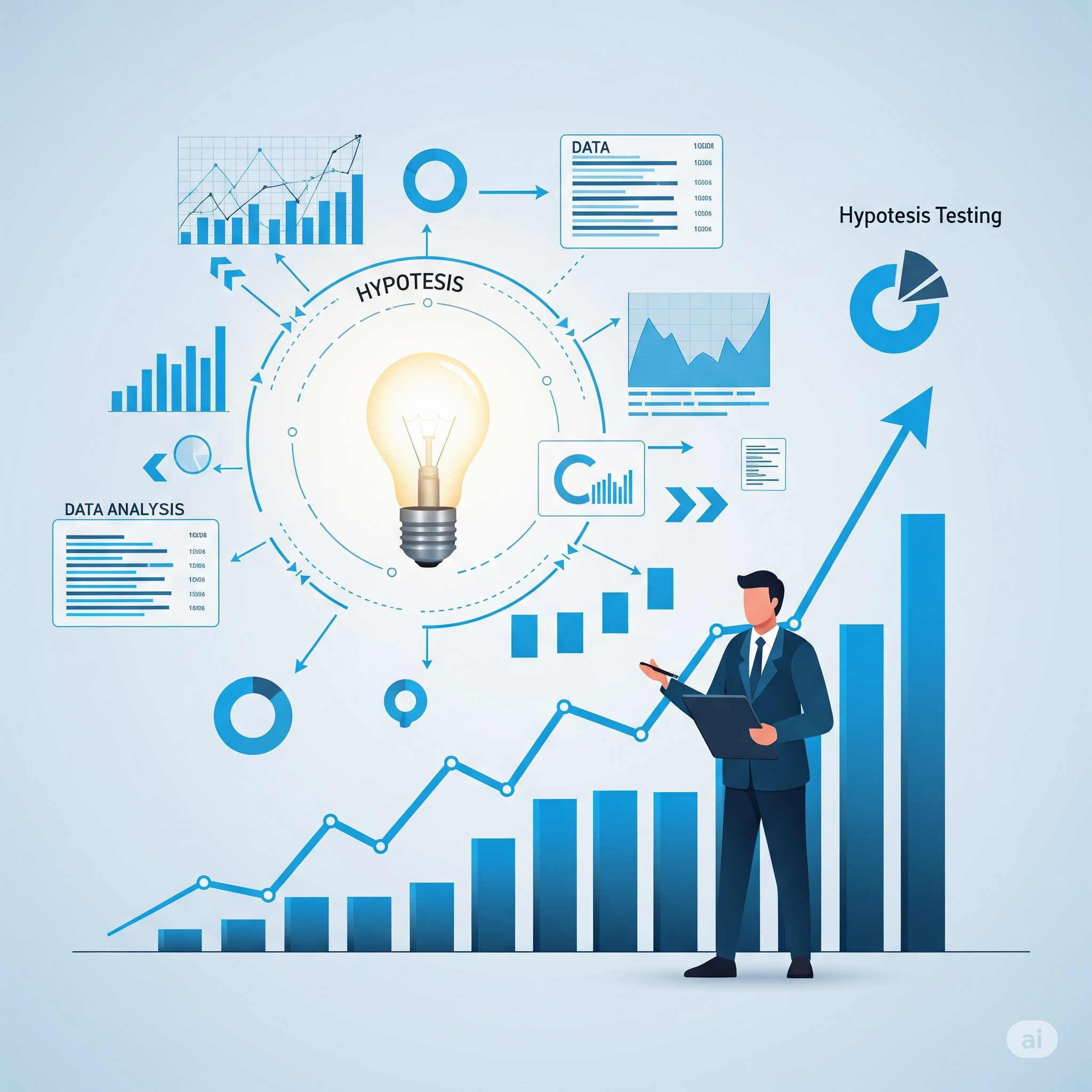
“The only relevant test of the validity of a hypothesis is comparison of prediction with experience.” – Milton Friedman.
This profound statement from the Nobel laureate Milton Friedman perfectly encapsulates the essence of hypothesising, a cornerstone of scientific inquiry that holds immense, often untapped, power for organisational success. While data science professionals are intimately familiar with hypotheses as guiding stars in their analytical journeys, the true magic unfolds when this structured approach permeates every level of an organisation.
What Exactly is a Hypothesis in an Organisational Context?
At its simplest, a hypothesis is an educated guess or a proposed explanation for an observation. We often see them as “If X happens, then Y will happen” statements – for example, “If I water the plants, then the plants will grow.” In the realm of data science, a hypothesis is a proposed explanation about a specific aspect of a problem or a pattern within a dataset, guiding our investigation and analysis.
But when we zoom out to the broader organisational landscape, hypothesising becomes a potent strategic tool. It’s about formulating intelligent predictions about various facets of your business environment, internal processes, or even the efficacy of a new strategy. These aren’t wild guesses; they are informed guesses, serving as a critical starting point for investigation and testing, helping organisations navigate the inherent uncertainties and complexities of pursuing their goals.
Hypothesising for Smarter Strategy Development
Imagine charting your organisation’s course without a clear map. That’s what many businesses do when they don’t leverage the power of hypotheses in strategy development. By formulating hypotheses about:
- Market trends: If younger demographics are increasingly conscious of sustainable products, then our market share in eco-friendly goods will grow.
- Customer behaviour: If we simplify our online checkout process, then our conversion rate will increase.
- Competitor strategies: If our competitor launches a new pricing model, then our customer churn rate in the mid-tier segment will rise.
- Internal capabilities: If we invest in upskilling our sales team on new CRM software, then their lead conversion efficiency will improve by 15%.
Organisations can move beyond mere intuition to make deliberate, data-driven decisions. These hypotheses aren’t set in stone; they are designed to be tested through market research, data analysis, and even small-scale experiments. This iterative process fosters an agile and adaptable approach to strategy, ensuring your business remains aligned with ever-changing market dynamics.
Driving Continuous Improvement Through Iterative Hypothesising
Beyond grand strategic shifts, hypothesising is invaluable for the relentless pursuit of continuous improvement. Think of it as a compass guiding teams to pinpoint potential areas for enhancement, whether it’s:
- Identifying bottlenecks in operational processes.
- Boosting employee productivity.
- Elevating customer experiences.
Consider an e-commerce company grappling with low online sales. Instead of blind guesswork, they developed three hypotheses to test using data:
- Hypothesis 1: If we prominently display customer reviews on product pages, then our conversion rate will increase due to enhanced trust. (Data: A/B test of product pages with and without reviews, tracking conversion rates.)
- Hypothesis 2: If we tailor marketing messages to specific customer demographics, then conversion rates for those cohorts will improve. (Data: Segmenting marketing campaigns by demographic and analyzing cohort-specific conversion rates.)
- Hypothesis 3: If we optimize our product descriptions for clarity and benefit-driven language, then the add-to-cart rate will increase. (Data: A/B testing different product description variants and measuring engagement metrics.)
By systematically testing these hypotheses and analyzing the relevant data, the company can make truly informed decisions. If the analysis supports Hypothesis 2, they can confidently tailor marketing campaigns to specific cohorts. If Hypothesis 3 proves true, the optimized product description becomes the new standard.
This iterative cycle of hypothesise, test, learn, and refine fosters a vibrant culture of innovation and learning. It empowers teams to continually experiment with different solutions, measure their outcomes, and ultimately drive efficiency, growth, and sustained success.
In the age of abundant data, the ability to formulate, test, and act upon hypotheses is no longer just a scientific nicety; it’s a critical capability for any organisation striving to thrive. It’s about asking the right questions, in the right way, to unlock the insights hidden within your operations and ultimately, shape a more successful future.

 Evangelos Bolofis | The AI Intersection